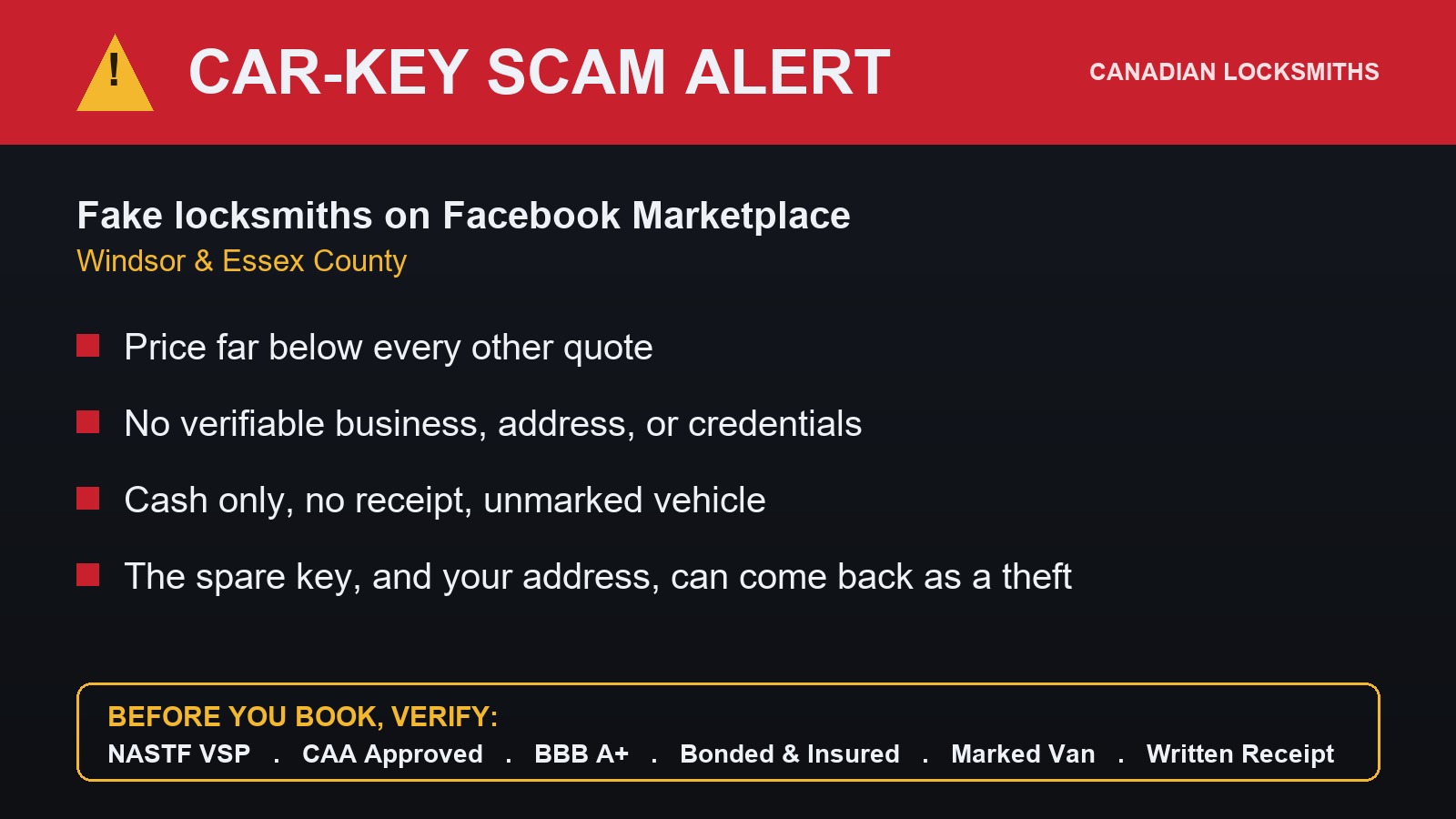
The warning every Windsor driver keeps seeing
A locksmith ad shows up in a Facebook Marketplace feed or a neighbourhood group. Car keys made on site, any make, half what everyone else quotes, come to you today. For a driver who just needs a spare or got locked out, it reads like a lucky find. Sometimes it is. Sometimes the person who shows up is not a locksmith at all.
This is not a Windsor-only worry, and it is not hype. CBC News has documented unlicensed and fake locksmith operations across Canada, including phoney online listings and review farms, in reporting like Scores of unlicensed locksmiths rip off customers and businesses alike, consumers warned. The CBC Marketplace investigation that followed pushed Google to begin auditing locksmith listings in Canada. The pattern is consistent: a flood of look-alike listings, prices set below everyone else to win the click, and no verifiable business behind the phone number. Windsor and Essex County drivers shop the same Marketplace feeds as everyone else, so the same bait lands here.
The version that should worry a car owner most is not the overcharge at the door. It is the job that goes smoothly, the key that works, and the theft that comes a week later.
How the Facebook Marketplace locksmith scam actually works
Strip away the marketing and the mechanics are simple. A below-market price pulls in a caller who needs a key or a lockout. The operator gets full, unsupervised access to the vehicle. While the job is done, a working duplicate is cut or a second key is paired to the car. The owner pays, often in cash, and the operator drives off. Nothing feels wrong. The key works.
The exposure is the spare nobody talked about. Whoever cut that extra key now has a way into the vehicle, and in many cases they also have the owner's name, address, and a photo of the car and plate from the booking conversation. In some reported schemes the operator never returns personally. After the spare is made, the duplicate key plus the customer's address is passed, or sold, to someone else, who takes the vehicle days later. Splitting the job that way is deliberate. The person who was standing in the driveway is not the person who drove the car away, so there is no obvious line connecting the theft back to the locksmith who made the key. This is described here as a reported pattern, not a how-to. The point for a car owner is the standing risk: an operator who cannot be identified or traced, who now holds a working key and your address, is a problem that does not end when the appointment does.
Other versions of the same scam never get that far. A deposit or e-transfer is requested up front to hold the appointment, and the operator simply vanishes. Or the quote triples once the work is half done and the vehicle is open, a classic bait-and-switch with the customer over a barrel. Cash only, no receipt, no business name on the vehicle, and a phone number that stops answering the next day are the common threads.
Why a real late-model key job cannot be done the way the scam promises
The technical reality is the best lie detector here. On most vehicles built in roughly the last decade, a key is not just a cut piece of metal. It is a transponder and a remote that have to be enrolled into the car's immobilizer, and on newer platforms that enrolment is gated behind manufacturer security. A legitimate automotive locksmith reaches it as a NASTF-authorized Vehicle Security Professional (VSP), the North American credential that grants vetted locksmiths manufacturer-authorized access to immobilizer data and security PINs. That access is logged against a specific technician and a specific vehicle.
Pulling that off needs real diagnostic tooling, a current software subscription, and on many 2018-and-newer vehicles a secure-gateway unlock before the car will even accept a new key. None of that is free, and none of it is instant. So a promise of any car, any time, at a price well below the market is not evidence of a lean operator. It is evidence that the person either cannot do the job properly or is not planning to make money on the key at all. Canadian Locksmiths covers the honest version of this coverage question in which 2020+ car keys a locksmith can actually make in Windsor, and the technical floor is the same point: real key origination has real costs.
Red flags before you book (Windsor edition)
Most of these can be checked in a few minutes, before anyone touches the vehicle.
- A price far below every other quote. Real key work has a known floor. A number that undercuts everyone is the lure, not a discount.
- No verifiable business. No real Windsor address, no business name, no credentials that can be looked up. A legitimate operator can be found in more than one place that the operator does not control.
- Pressure for a deposit or e-transfer to hold the slot. A real locksmith bills for completed work, not for the privilege of an appointment.
- Cash only and no written receipt. No paper trail protects the operator, not the customer.
- An unmarked vehicle and a number that goes quiet. A real mobile locksmith arrives in a marked vehicle and stays reachable after the job.
- Perfect, thin reviews that all sound the same. Review farms are part of the playbook the CBC investigation exposed. Look for reviews with specifics, history, and a verifiable profile, the kind on the Canadian Locksmiths reviews page.
- Vague credential claims. Licensed, bonded, and insured with no specifics is a line anyone can type. The credentials that actually exist are listed and explained in how to verify a Windsor automotive locksmith is credentialed.
How a legitimate locksmith protects you and your vehicle
The honest version of this work is built to be traceable, which is exactly what a scammer avoids. Canadian Locksmiths arrives in a marked vehicle, gives a written receipt, and holds verifiable third-party credentials: active NASTF VSP registration, CAA Approved status, a Better Business Bureau A+ rating, and commercial liability insurance. Each one can be confirmed in its issuing directory before a key is cut. A mobile locksmith who can be identified, looked up, and held accountable has no path to the come-back-later scheme, because the work points straight back to a named, insured business.
There is also a quieter safeguard that works in the owner's favour. A legitimate locksmith has every reason to confirm the car is being keyed for its rightful owner, and a scammer has none. Canadian Locksmiths may, at its sole discretion, request proof of vehicle ownership or identity before, during, or after performing services. Proof may include government-issued photo identification, vehicle registration, or other documentation. The decision to request, accept, or waive any particular form of verification rests entirely with Canadian Locksmiths and does not create an obligation to verify ownership in every transaction. An operator who never cares who owns the car is telling you something about the operator.
What to do if you think you have been scammed
If a key was made by someone who cannot be verified, treat the vehicle as if a spare is in the wrong hands, because it may be.
- Report it. Contact the Windsor Police Service to file a report, and keep every message, listing, and payment record from the booking.
- Tell your insurer. A documented report matters if the vehicle is later taken, and your insurer can advise on coverage and next steps.
- Re-secure the vehicle. A credentialed locksmith can re-pair the immobilizer and erase old keys from the car's memory so any duplicate that was made will no longer start the engine. On platforms that support it, this is the same procedure used for all-keys-lost recovery and key replacement, and it closes the door a cloned key left open. If the work was a spare or duplicate key done off the books, having it redone and re-secured by a verifiable locksmith resets the situation.
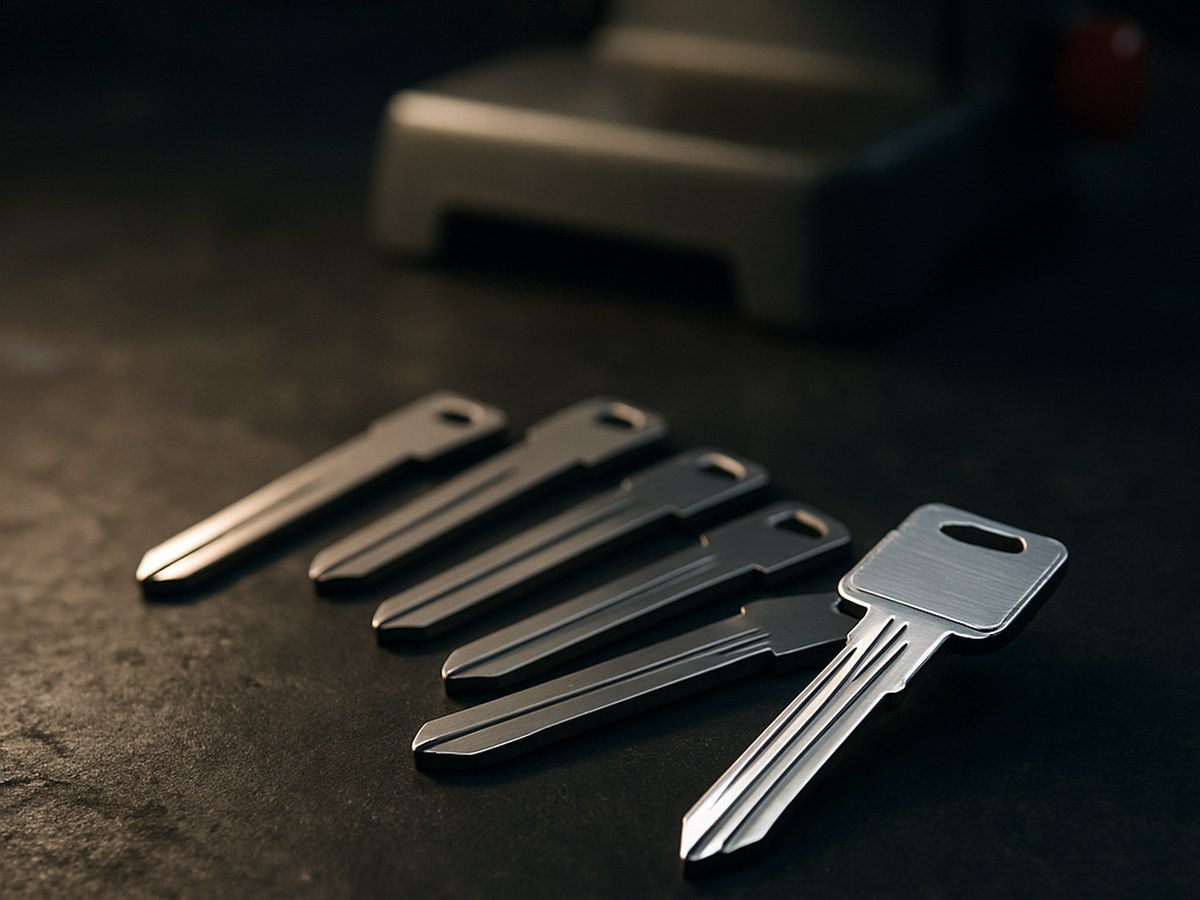
The cost of re-securing a vehicle is small next to the cost of losing it. The better move, when there is time, is to never hand unsupervised access to an operator who cannot be identified in the first place.
Frequently asked questions
Q: Are Facebook Marketplace locksmiths safe to use? A: Some are, many are not. Marketplace and neighbourhood groups are exactly where fake and unlicensed locksmith listings concentrate, which is what the CBC Marketplace investigation documented across Canada. The platform is not the problem on its own. The problem is hiring anyone whose business, address, and credentials cannot be verified before they reach the vehicle.
Q: Can someone really clone my car key and steal my car later? A: A duplicate or paired key gives someone a working way into and, on many vehicles, a way to start the car. If an unverifiable operator made a key and also has your address, the risk does not end when they drive off. Re-pairing the immobilizer through a credentialed locksmith removes that risk by erasing keys the car no longer should trust.
Q: How do I check that a Windsor locksmith is legitimate? A: Confirm a real business name and Windsor service area, look up third-party credentials such as NASTF VSP, CAA Approved status, and a Better Business Bureau rating, read reviews with real detail rather than a wall of identical five-star lines, and expect a marked vehicle and a written receipt. The full checklist is in how to verify a Windsor automotive locksmith is credentialed.
Q: What should a real car key actually cost in Windsor? A: A basic transponder duplicate when a working key is present starts around $99. Smart key fob programming for late-model vehicles typically runs $199 to $499+, and all-keys-lost recovery on encrypted platforms can reach $499 to $1,500+ depending on the vehicle. A quote far below that range is the warning sign, not the deal.
Q: Does a real locksmith ask for proof of ownership? A: Canadian Locksmiths may, at its sole discretion, request proof of vehicle ownership or identity before, during, or after performing services, and may decline service where ownership cannot be reasonably established or fraud is suspected. A legitimate operator has every reason to care who owns the vehicle. A scammer does not. Questions are welcome any time on the FAQ page or by phone.
Q: I think I already used a fake locksmith. What now? A: Report it to the Windsor Police Service, notify your insurer, and have a credentialed locksmith re-secure the vehicle by re-pairing the immobilizer so any key that was made no longer works. Acting before anything happens is far better than after.